The garden mirror edit
How to choose and place a garden mirror: glass versus acrylic, frames that weather well, safe positioning and the placements that genuinely transform a space.
When you shop through links in this article, TOSE may earn a commission and members earn cashback.
The garden mirror is the cheapest extension you will ever build. Hung well, it lends a small garden a second room, returns light to a shaded corner, and gives a flat fence something like a view. Hung badly, it announces itself as a mirror on a fence. The difference is a handful of decisions made before anything goes on the wall.
The first is material. Glass gives the truest, stillest reflection and the most convincing illusion, at the price of weight and fragility, so it wants a solid wall or a sturdy fence post and proper fixings. For glass, choose an outdoor-rated mirror using appropriate safety glass or protective backing, rather than adapting an ordinary indoor mirror: the backing and edges of an indoor mirror may deteriorate outdoors, producing darkening, corrosion or peeling over time. Acrylic weighs far less and is generally more forgiving around play, making it useful on lighter structures and in family gardens, but it can flex, and a flexed mirror ripples the reflection just enough to break the spell. As a rule of thumb, the more the mirror is meant to read as a window or doorway, the stronger the case for glass; the more decorative and plant-wrapped the role, the more forgivable acrylic becomes.
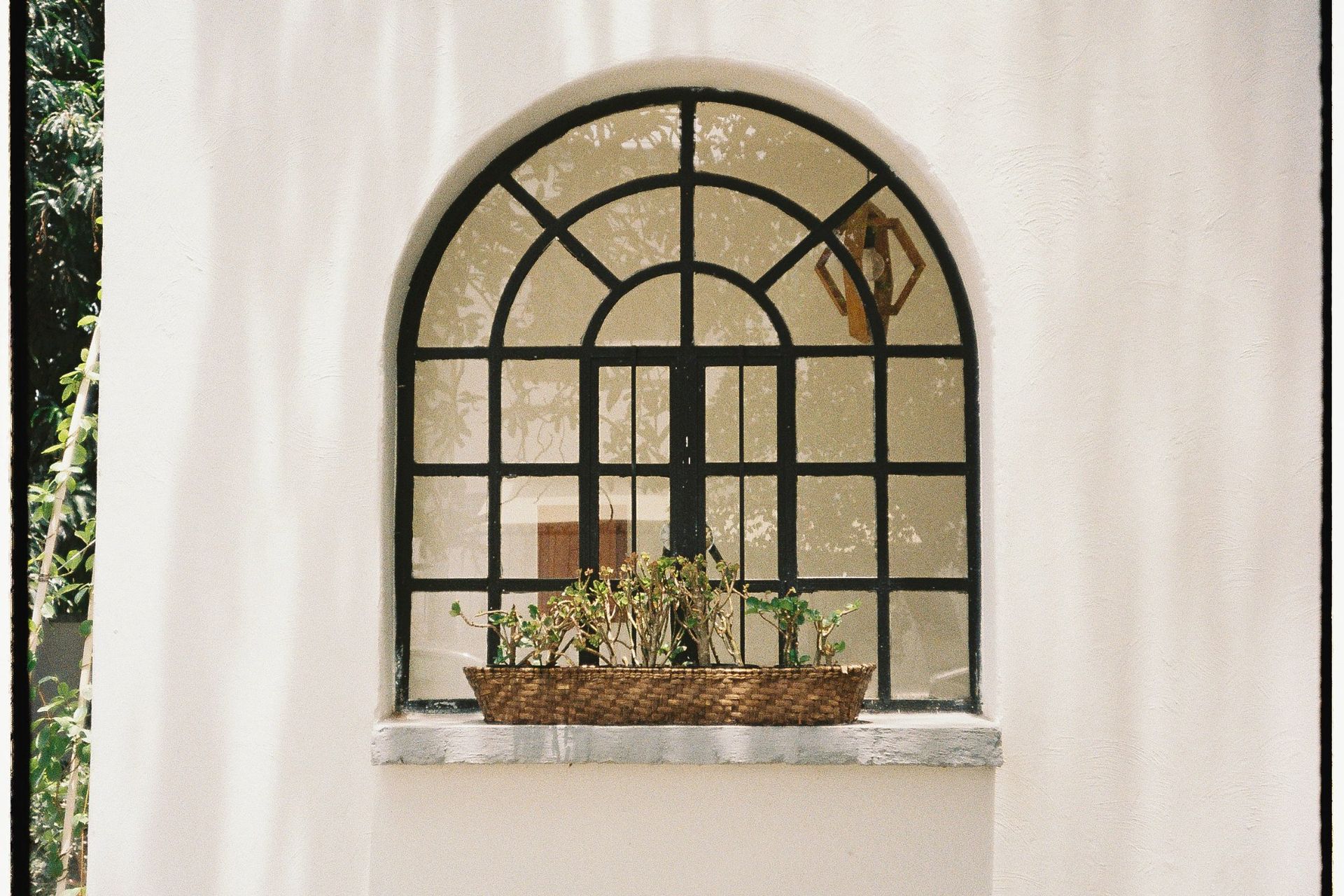
The second is shape and frame, which set the register. An arched or window-paned mirror leans into the illusion, reading as a gate to a garden beyond, and suits being framed by climbers. A simple round mirror behaves more like a pool of light and flatters modern planting. Frames need to be honest about the weather: powder-coated metal and properly treated hardwood age gracefully; untreated bargain frames do not, and a rusting frame stains the wall beneath it. Matt dark frames disappear into planting; pale and metallic ones become features in their own right.
Placement is where the transformation actually happens. The mirror should reflect something worth doubling: planting, a path, a fine tree, never the shed, the bins, or, most disillusioning of all, you, standing at the kitchen window. Setting it at a slight angle, rather than square-on to the viewer, keeps the reflection green and stops the eye meeting itself. Partially veiling the edges with climbers or tall planting hides the frame's hard line and does most of the work of the illusion.
Two safety considerations deserve their own attention rather than an afterthought. A garden mirror needs to be considered from a bird's point of view: reflections of sky or planting can be mistaken for open habitat, so avoid placing a large uninterrupted reflective surface in an active flight path, and where collision risk exists, decorative divisions, external markings or planting immediately in front of the surface can help break up the apparent opening. And keep the mirror away from positions where direct sun can throw intense glare towards a neighbour, a window, dry planting or another combustible surface. Reflected and focused sunlight has caused fires, so check the path of the reflection at different times of day rather than judging the position once. Fix it as you would anything heavy outdoors: use exterior-grade fixings suited to both the mirror's weight and the wall or timber behind it; a decorative fence panel alone may not be enough. Check them after winter and after severe weather.
Fixing it to what you actually have
The fixing is decided by the surface behind the mirror, and most failures come from treating all vertical surfaces as equivalent.
Masonry is the straightforward case. A brick or block wall takes the weight of a glass mirror through appropriate wall plugs and screws rated for outdoor use, with the fixings set into the brick rather than the softer mortar joint where possible. Rendered walls hide what is behind them, so it is worth finding out whether the render sits on masonry or on a lighter build-up before choosing a fixing.
Timber is where judgement is needed. A fence post is structural; a fence panel usually is not. Panels are designed to resist wind, not to carry a hanging load, and a heavy mirror fixed to the middle of a panel puts weight where the panel is weakest. Where a mirror is going on a fence, the fixings want to reach the posts or the rails behind the boards, and a lighter acrylic panel is the more sensible choice if they cannot.
Freestanding is the third option. A mirror leaned against a wall behind planting, or mounted on its own frame, avoids drilling into the wall, but it still needs to be secured against wind and impact.
Aspect, and what the light is doing
A mirror does not create light; it moves it. Which direction it faces therefore decides most of the effect.
A mirror on a shaded wall opposite a sunlit part of the garden borrows that brightness and is usually the most rewarding position, because it returns light to the corner that has none. A mirror facing directly into strong afternoon sun does the opposite: it becomes a bright rectangle rather than a view, and it is the position most likely to raise the glare question above.
The practical method is to stand where you actually sit, at the times you actually sit there, and hold the mirror up before fixing anything. The reflection you want is the one visible from the bench or the kitchen door, not the one visible from directly in front of the wall.
Keeping it looking like a view
Outdoor mirrors accumulate the things gardens produce: pollen in spring, dust in summer, leaf debris and algae in autumn.
Clean glass with a soft cloth rather than an abrasive, and keep water away from the frame joint and the backing edge, since that is where deterioration starts. Acrylic scratches far more easily than glass and wants a soft cloth and a gentle cleaner rather than anything gritty. Trim back climbers that have moved from veiling the edges to covering the surface, which happens faster than expected in a good growing year.
Where to shop: the sheltered garden
A necessary distinction first. These are interior mirrors, so their place outdoors is under cover: a deep porch, a veranda, a garden room, the protected wall of a loggia. Kept from direct rain, they can still borrow light, double planting and lend a small space the illusion of another opening. For an exposed wall, choose a mirror made specifically for outdoor use.
La Redoute is particularly good on the architectural sort. The black-steel Rochford has the clean authority of a proper arched window and would sit beautifully against pale render or dark planting. The Lenaig mirrors are more emphatic: one at 120 by 90cm, the other a generous 110 by 170cm, both divided into industrial panes that climbers will soften rather than obscure. The 35cm Nadima is the decorative counterpoint, a small wavy disc for a covered corner where the intention is light rather than illusion. And in a garden room, the 170cm Mayra leaner has the scale to behave like a second opening, provided it is properly secured and kept entirely within the shelter of the structure.
Size, last. The common mistake is timidity: a small mirror on a large fence reads as an ornament, where one generous piece reads as architecture. Measure the wall, then choose the mirror you think is slightly too big. Gardens absorb scale outdoors in a way hallways never do, and the whole point of the exercise is more garden.